

Introduction
In the manufacturing of world-class automotive components, shaping the metal is only half the battle. When a 10,000-ton hydraulic press crushes a solid billet of aluminum into a custom forged wheel, it successfully establishes a dense, aligned grain structure. However, immediately after this violent physical forging process, the aluminum is surprisingly soft, malleable, and completely unfit to support the weight of a high-performance vehicle.
To transform that raw, shaped metal into an ultra-rigid, track-ready component, it must undergo a rigorous, highly controlled thermal sequence. This is the science of heat treatment.
For the premier aerospace-grade alloy used in the industry—6061 aluminum—the ultimate thermal conditioning is known as the T6 process. Understanding how this process chemically and structurally alters the metal is crucial for automotive enthusiasts demanding peak performance, and it is absolutely vital for B2B distributors sourcing inventory from an OEM wheel supplier.
At CN Wheel Rims (CNWR), our automated, precision-controlled heat treatment facilities ensure that every forged wheel we produce reaches its absolute maximum yield strength. In this comprehensive guide, we will dissect the three critical phases of the T6 process, explain the metallurgy of precipitation hardening, and reveal why uncompromising heat treatment is the ultimate differentiator in the forged wheel market.
The Core Problem: Why Does Aluminum Need Heat Treatment?
Pure aluminum is incredibly lightweight and highly resistant to corrosion, but it is inherently weak. To make it viable for automotive use, it is blended with alloying elements—specifically magnesium and silicon to create the 6000-series alloys.
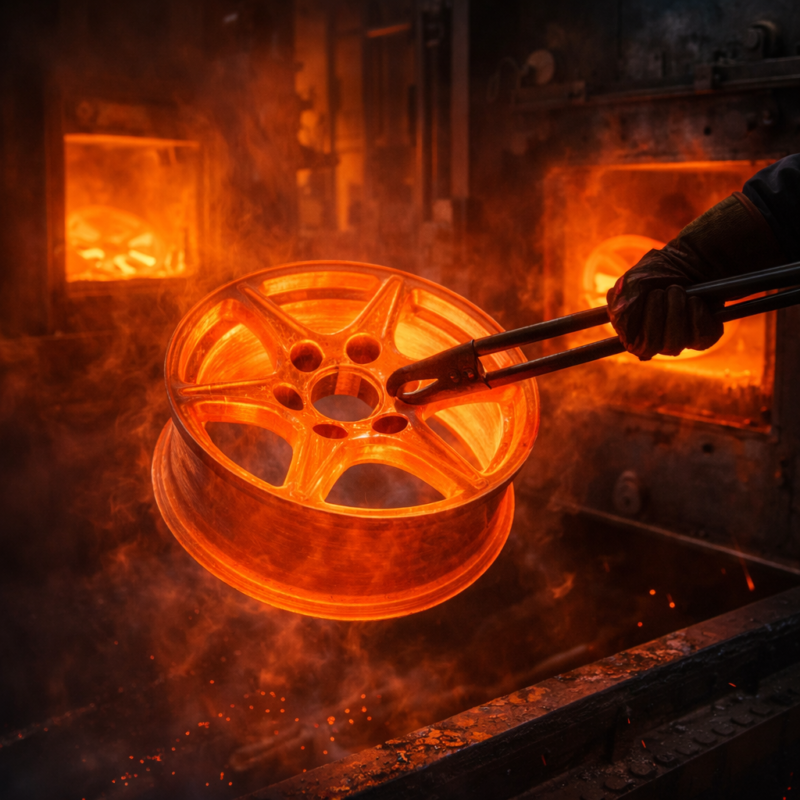
During the initial forging phase, the metal is heated to make it pliable enough to be pressed into a wheel blank. However, this uncontrolled heating and subsequent slow cooling causes those alloying elements to clump together unevenly at the microscopic level. The result is a metal structure that can easily slip and bend under stress.
Heat treatment in forged wheels is the process of using extreme, precisely calibrated temperature cycles to force those alloying elements to distribute evenly and lock the aluminum’s molecular structure into a rigid, unyielding matrix.
The 3 Phases of the T6 Heat Treatment Process
The “T6” designation is not a marketing term; it is an exact metallurgical prescription. To achieve a true T6 temper, the wheel blank must pass through three distinct, time-sensitive thermal phases.
Phase 1: Solution Heat Treating (Solutionizing)
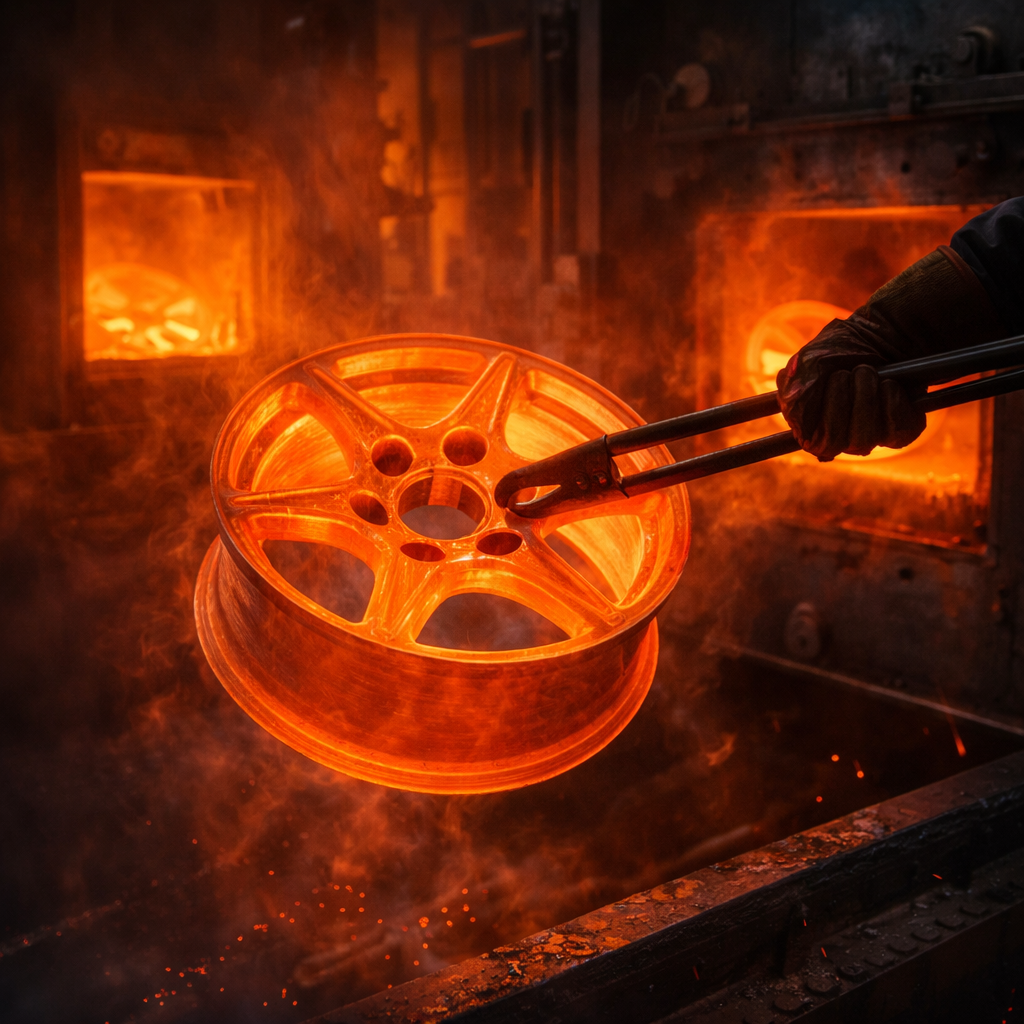
The first step is to completely “reset” the metal’s internal chemistry. The newly forged wheel blanks are placed into a massive, highly regulated thermal furnace and heated to a critical temperature of approximately 530°C (985°F).
At this extreme temperature, the solid metal is just below its melting point. The magnesium and silicon atoms completely dissolve and diffuse evenly throughout the aluminum matrix, creating what is known as a “solid solution.”
-
Analogy: Think of stirring sugar into hot tea until the sugar completely dissolves and distributes evenly throughout the liquid.
Phase 2: Rapid Quenching
This is the most time-sensitive and volatile step in the wheel manufacturing process. Once the alloys are perfectly dissolved, the wheel blanks must be rapidly cooled to trap the magnesium and silicon atoms exactly where they are.
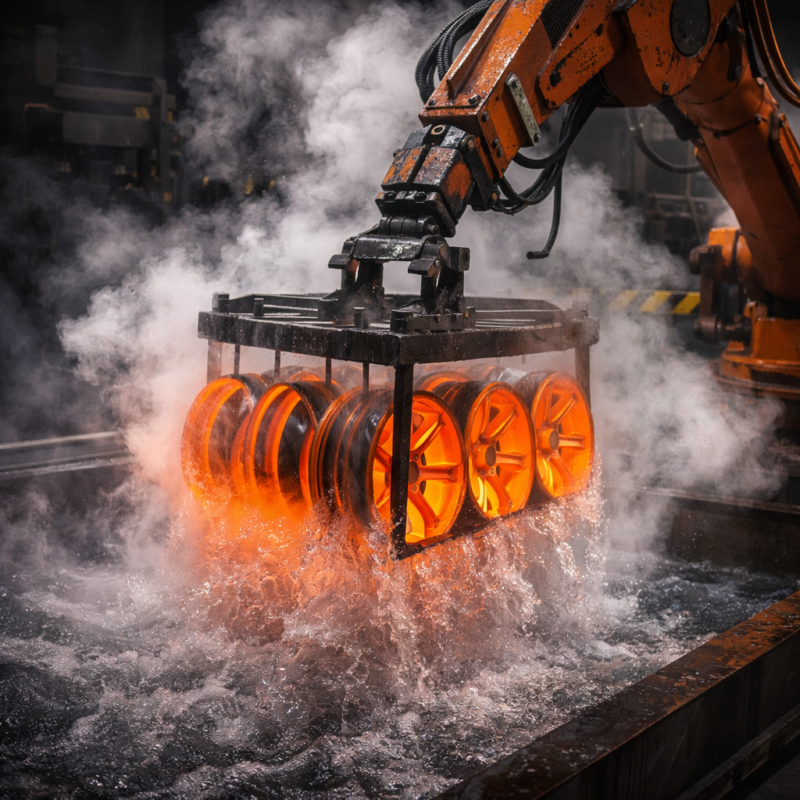
The glowing wheels are instantly removed from the furnace and submerged into a quench tank filled with water or a specialized polymer coolant. This rapid drop in temperature (usually taking less than 15 seconds) “freezes” the internal molecular structure. If the transfer from the furnace to the quench tank is too slow, the alloying elements will begin to clump together again, ruining the strength of the final wheel.
Phase 3: Artificial Aging (Precipitation Hardening)
Immediately after quenching, the wheel is technically in a “T4” temper. It is highly unstable and will naturally harden over time at room temperature. However, natural aging does not provide enough strength for high-performance automotive applications.
To achieve the T6 temper, the wheels undergo artificial aging. They are placed into a secondary oven and heated to a moderate temperature—typically between 160°C and 175°C (320°F to 350°F)—for an extended period of 8 to 12 hours.
During this controlled baking process, the trapped magnesium and silicon atoms bond together to form microscopic particles called precipitates (Mg2Si). These precipitates act like millions of microscopic deadbolts, locking the crystalline “slip planes” of the aluminum together. This specific mechanism is known as precipitation hardening, and it is what gives a custom forged wheel its immense, uncompromising strength.
The Scientific Result: T6 vs. Other Tempers
To truly appreciate the necessity of the T6 process, we must look at the hard data. How much does heat treatment actually improve the 6061 aluminum alloy?
| Metal Temper State | Yield Strength (Stress before bending) | Ultimate Tensile Strength (Stress before breaking) | Description |
| 6061-O (Annealed/Raw) | ~55 MPa (8,000 psi) | ~125 MPa (18,000 psi) | Raw, un-treated aluminum. Soft, easily bent, unusable for wheels. |
| 6061-T4 (Naturally Aged) | ~145 MPa (21,000 psi) | ~240 MPa (35,000 psi) | Solutionized and quenched, but aged at room temperature. Inadequate for heavy vehicle loads. |
| 6061-T6 (Artificially Aged) | ~276 MPa (40,000 psi) | ~310 MPa (45,000 psi) | Fully heat-treated via precipitation hardening. The gold standard for forged wheels. |
Data Note: The T6 heat treatment process increases the yield strength of the raw forged aluminum by nearly 500%.
How T6 Heat Treatment Impacts Wheel Performance
For the end-user—whether they are a professional race car driver or a luxury SUV owner—the invisible science of the T6 process translates to highly visible, real-world performance benefits.
1. Unmatched Impact Resistance
Because precipitation hardening locks the slip planes, a 6061-T6 wheel can absorb massive kinetic energy without deforming. When a vehicle strikes a severe highway pothole or aggressive track curbing, the high yield strength ensures the wheel lip does not bend, preventing a sudden loss of tire air pressure (bead failure) and keeping the occupants safe.
2. Extreme Lightweight Capabilities (Unsprung Mass)
If a wheel manufacturer uses inferior heat treatment, they must compensate for the weaker metal by designing thicker, heavier spokes to meet the required load rating. Because the T6 process maximizes the metal’s strength, CNWR engineers can utilize multi-axis CNC machining to mill away excess material, creating ultra-thin, aerodynamic spoke profiles. This drastically reduces the vehicle’s unsprung mass, resulting in faster acceleration, sharper steering response, and shorter braking distances.
3. Superior Cyclic Fatigue Life
Wheels are subjected to constant, cyclic stress. As the wheel rotates under the weight of the car, every spoke goes through a cycle of tension and compression. The dense, precipitate-locked structure of a T6 wheel prevents microscopic fatigue cracks from forming, ensuring the custom forged wheel lasts for decades of daily driving or heavy track abuse.
Why Heat Treatment is the Ultimate Litmus Test
For B2B wholesale buyers, aftermarket brand owners, and distributors, your entire reputation hinges on the structural integrity of the products you supply. Understanding the heat treatment process is critical when auditing an OEM wheel supplier.
The Danger of “Short-Cycling”
Heat treatment is the most time-consuming and energy-intensive phase of wheel manufacturing. Running industrial furnaces at high temperatures for 12 hours consumes massive amounts of electricity.
Some budget-tier manufacturers attempt to cut costs and speed up production times by “short-cycling” the artificial aging process—baking the wheels for only 4 to 6 hours instead of the required 8 to 12. This creates a wheel that looks like a premium forged product but possesses the dangerous, weak yield strength of a T4 temper. These wheels are highly susceptible to cracking and catastrophic failure under load.
The CNWR Guarantee: Certified T6 Processing
At CNWR, we view heat treatment as the most critical safety protocol in our factory.
-
Automated Precision: Our thermal furnaces are digitally monitored, ensuring temperature fluctuations do not exceed ±2°C during the entire 12-hour aging cycle.
-
Rigorous QC Testing: Following the T6 process, samples from every batch undergo destructive tensile testing and microscopic hardness testing to verify that exact precipitation hardening has been achieved.
-
Global Certifications: Because our T6 process is uncompromised, CNWR wheels easily pass the world’s most brutal independent safety tests, including TÜV (Germany), VIA, and JWL (Japan).
When you partner with CNWR for your custom OEM/ODM wheel line, you are guaranteeing your clients a product that delivers on the true promise of forged engineering.
Frequently Asked Questions (FAQs)
Can you powder coat a T6 forged wheel without ruining the heat treatment?
Yes, but temperature control is critical. Powder coating requires baking the wheel at around 200°C (390°F) for 15 to 20 minutes to cure the powder. Because this is a short duration and slightly above the artificial aging temperature, it does not significantly alter the T6 grain structure. However, subjecting a wheel to extreme heat for prolonged periods (such as welding a cracked barrel) will destroy the T6 temper in that localized area, making the wheel permanently unsafe.
Does flow-forming a wheel involve the T6 process?
Yes, reputable flow-formed (or rotary forged) wheels also undergo T6 heat treatment. After the cast center is mated to the spun-forged barrel, the entire wheel must be solutionized, quenched, and artificially aged to ensure both the cast and forged sections reach their maximum potential strength.
How can I tell if a wheel has been properly T6 heat-treated?
Visually, you cannot. A weak, short-cycled wheel looks identical to a properly aged T6 wheel. The only way to verify is through metallurgical lab testing or by demanding to see the manufacturer’s independent safety certifications (like TÜV or VIA), which require the wheel to survive brutal impact and radial fatigue stress tests that a non-T6 wheel would fail.
Are 3-piece forged wheels T6 heat-treated?
Yes. In a multi-piece custom forged wheel, all three individual components—the forged center face, the spun inner barrel, and the spun outer lip—are individually subjected to the complete T6 heat treatment process before they are CNC machined, finished, and bolted together.
Conclusion
The breathtaking design of a custom forged wheel is brought to life by CNC machining, but its soul—its unyielding strength, safety, and performance—is forged in the fires of the T6 heat treatment process.
Solutionizing, quenching, and artificial aging are not just manufacturing steps; they are the exact metallurgical science of precipitation hardening. This controlled thermal sequence is the invisible barrier standing between a safe, high-speed track day and a catastrophic wheel failure.
As a premier OEM wheel supplier, CN Wheel Rims (CNWR) refuses to compromise on science. Our state-of-the-art heat treatment facilities ensure that every single wheel bearing our name, or the name of our B2B partners, represents the absolute pinnacle of 6061-T6 aluminum engineering.