

Introduction
In the performance automotive industry, the term “forged” is synonymous with ultimate strength, premium quality, and high-end engineering. Automotive enthusiasts, race teams, and luxury vehicle owners inherently know that custom forged wheels are superior to their cast counterparts. However, the exact reason why they are stronger is rarely understood on a deeper, scientific level.
The secret does not lie merely in the chemical composition of the alloy, but in the physical manipulation of the metal’s internal architecture. This metallurgical phenomenon is known as grain flow.
At CN Wheel Rims (CNWR), our automated manufacturing processes are precisely calibrated to optimize this very characteristic. As a leading OEM wheel supplier, we leverage millions of pounds of controlled hydraulic pressure to physically alter the crystalline structure of aerospace-grade aluminum.
In this comprehensive guide, we will explore the rigorous science of metallurgical grain flow, dissect how the forged wheel manufacturing process structurally improves the wheel, and explain why this science translates to immense value for B2B distributors, aftermarket tuners, and drivers alike.
What is Metallurgical Grain Flow?
To understand grain flow, one must first understand that solid metals are not uniform, featureless masses. At a microscopic level, metals are composed of tiny crystals called “grains.” When molten metal cools and solidifies, these grains form and grow until they bump into one another, creating a puzzle-like microscopic structure.
The best way to conceptualize grain flow is to compare it to a piece of wood. Wood has a distinct, visible grain pattern. If you attempt to chop a piece of wood parallel to the grain, it splits easily. However, if you try to chop perpendicular to (across) the grain, the wood is incredibly strong and resistant to breaking.
Metals exhibit a similar characteristic, known as anisotropy (having different physical properties in different directions). When a metal is mechanically deformed under extreme pressure while in a solid state, its microscopic grains stretch, flatten, and align in the direction of the force. This creates a continuous, directional grain flow that drastically increases the material’s yield strength and resistance to fatigue along those flow lines.
Cast Wheels vs. Forged Wheels: The Grain Structure Difference
The fundamental difference between a cheap budget wheel and a premium forged wheel comes down to how these microscopic grains are treated during the manufacturing phase.
The Chaotic Nature of Cast Aluminum
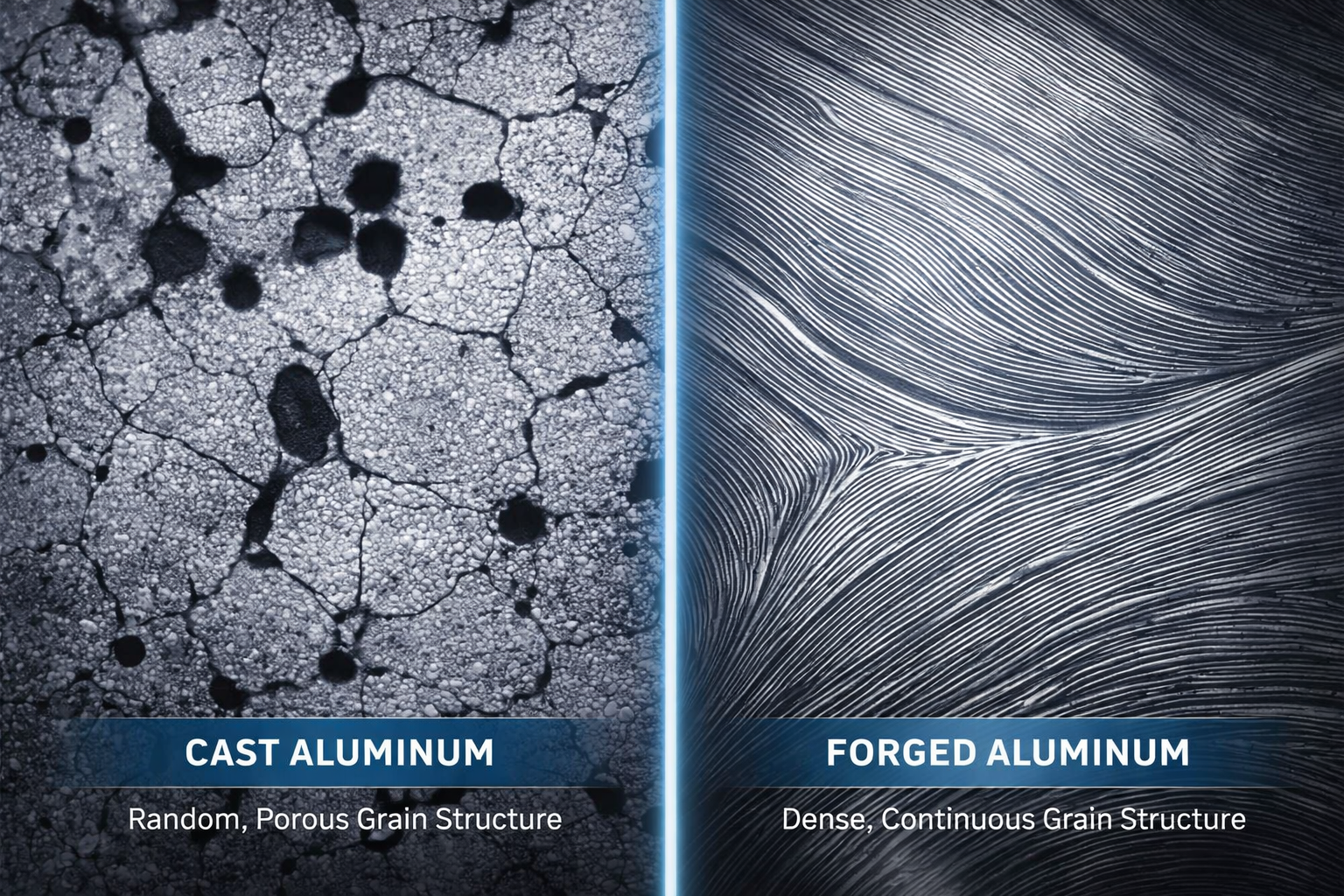
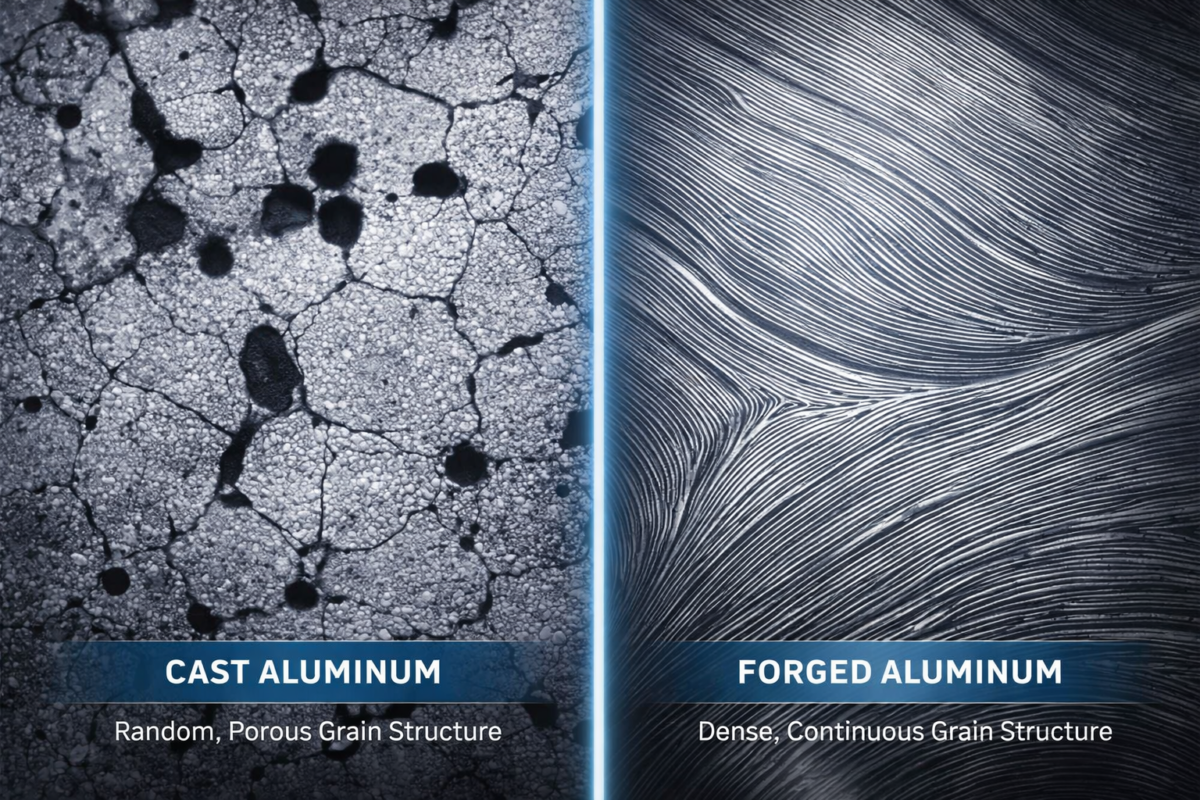
Traditional cast wheels are manufactured by heating aluminum until it is completely molten (liquid) and pouring it into a mold. As the liquid metal cools and hardens into the shape of the wheel, the crystalline grains form randomly.
This creates an isotropic structure, meaning the metal’s strength is generally the same in all directions, but that overall baseline strength is relatively low. Furthermore, as the molten aluminum cools, it inevitably traps microscopic gas bubbles, leading to porosity. This porous, random grain structure is brittle; under a severe impact, a cast wheel is highly prone to fracturing or shattering.
The Aligned Power of Forged Aluminum
Forged wheels begin as a solid billet of 6061-T6 aluminum. The metal is never melted. Instead, it is heated to a precise temperature where it becomes malleable but remains strictly in a solid state.
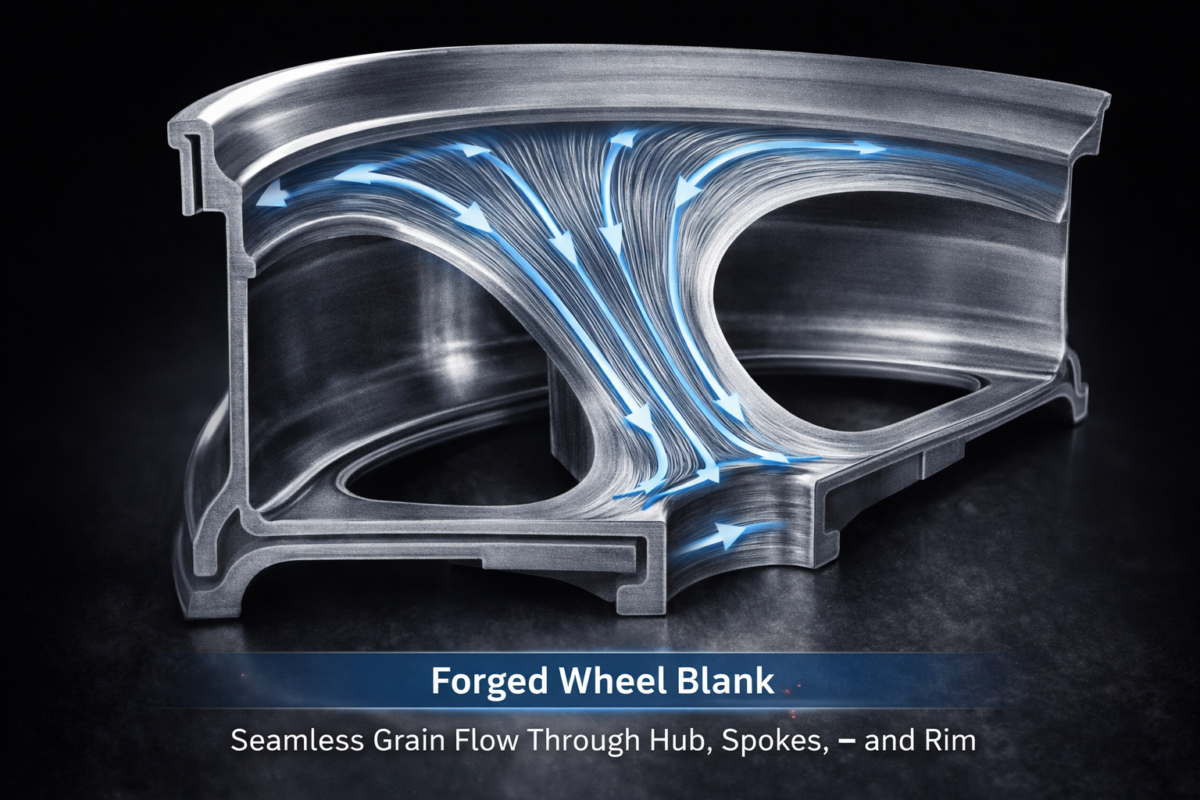
When immense pressure is applied, the metal is crushed into the shape of a wheel blank. Because the metal is forced to flow into its new shape while solid, the internal grain structure is stretched and directed to follow the exact contours of the wheel’s design. The grains interlock, overlapping one another to create a dense, highly compressed matrix. Porosity is completely eradicated.
The CNWR Forging Process: Precision Control and Automation
Optimizing grain flow is an exact science that requires immense force managed by highly sophisticated control systems. At CNWR, our wheel manufacturing process integrates advanced automation to ensure absolute metallurgical perfection.
1. Controlled Thermal Heating
The 6061-T6 aluminum billet is placed into automated, closed-loop thermal furnaces. The temperature must be maintained with pinpoint accuracy. If the billet is too cold, it may crack under pressure; if it is too hot, the grain structure can become coarse, losing its strength benefits. Our automated sensors ensure the billet reaches the exact optimal temperature for plastic deformation.
2. The 10,000-Ton Hydraulic Press
The heated billet is transferred to a massive, custom-tooled hydraulic forging press. With automated precision, the press applies upwards of 10,000 tons of raw pressure. This is the exact moment the grain flow is established. The press literally forces the aluminum to flow like a highly viscous clay, directing the grain lines to sweep from the center mounting pad directly out into the spoke profiles.
3. Spin Forging the Barrel
To further enhance the grain structure of the wheel’s outer barrel, we utilize a secondary CNC-controlled flow-forming (or spin-forging) process. The forged blank is spun at high speeds while automated hydraulic rollers apply immense lateral pressure to stretch the aluminum barrel to its final width. This action compresses the grain structure in the barrel even further, aligning it circumferentially around the wheel, which drastically increases the barrel’s resistance to bending from pothole impacts.
Head-to-Head: Random vs. Aligned Grain Properties
To illustrate the scientific difference grain flow makes, observe how physical properties shift between standard casting and precision forging:
| Property | Cast Aluminum (Random Grain) | Forged 6061-T6 (Aligned Grain Flow) | The Scientific Result |
| Porosity Level | High (Micro-voids present) | Zero | Forged metal is dramatically denser. |
| Yield Strength | ~165 MPa | ~276 MPa | Forged wheels can withstand nearly double the stress before deforming. |
| Tensile Strength | ~230 MPa | ~310+ MPa | Forged wheels handle extreme cornering and rotational G-forces safely. |
| Elongation / Ductility | Low (Brittle) | High (Elastic) | Cast wheels shatter on impact; forged wheels bend, maintaining air pressure. |
| Fatigue Resistance | Moderate | Exceptional | Forged wheels easily survive decades of cyclic rotational stress. |
How Grain Flow Directly Improves Wheel Performance
The optimization of grain flow is not just an academic exercise in metallurgy; it translates to profound, tangible benefits on the road and the racetrack.
1. Extreme Lightweighting (Reducing Unsprung Mass)
Because the aligned grain flow makes the 6061-T6 aluminum incredibly strong, CNWR engineers do not need to use as much physical material to achieve the necessary load ratings. Utilizing multi-axis CNC machines, we can mill away large pockets of aluminum from the hub and shave the spokes to razor-thin profiles. This drastically reduces the wheel’s weight and unsprung mass, resulting in faster acceleration, shorter braking distances, and highly responsive suspension dynamics.
2. High Load Capacity for Modern Vehicles
Modern vehicles are heavier than ever, particularly with the rapid adoption of high-performance Electric Vehicles (EVs) carrying dense battery packs. The continuous grain structure extending from the hub through the spokes provides an unbroken path of structural support, allowing forged wheels to boast massive load capacities capable of safely supporting ultra-heavy luxury SUVs and EVs under intense cornering forces.
3. Superior Impact Safety
Perhaps the most critical benefit of grain flow is how the metal behaves at its absolute breaking point. Because the grains are interlocked and continuous, a forged wheel acts like a high-tension spring. If you strike a severe road hazard at highway speeds, a cast wheel’s random grain structure acts like glass—it shatters, leading to immediate, catastrophic tire failure. The continuous grain flow of a forged wheel allows it to deform and bend, absorbing the kinetic energy while keeping the tire beaded to the rim, allowing the driver to safely bring the vehicle to a halt.
Why Grain Flow Matters to B2B Distributors and OEM Partners
For wholesale distributors, tuning shops, and automotive brands looking for an OEM wheel supplier, understanding the science of grain flow is a powerful commercial tool.
Marketing with Authority
Modern B2B and B2C consumers are highly educated. Simply saying “our wheels are strong” is no longer enough. By educating your clientele on the science of grain flow—explaining how the 10,000-ton press aligns the crystalline structure of the 6061-T6 billet—you elevate your brand’s authority (E-E-A-T) and justify the premium price point of custom forged wheels.
Zero-Compromise Liability
As a distributor, every product you sell carries your reputation. Sourcing wheels with scientifically verified structural integrity eliminates the headache of warranty claims, cracked rims, and angry customers. The predictable, documented yield strength of CNWR’s aligned-grain forged wheels ensures that your inventory will pass the world’s most stringent safety certifications (TÜV, VIA, JWL).
At CNWR, our automated manufacturing capabilities are designed to be an extension of your business. Whether you need a steady wholesale supply of lightweight monoblocks or fully custom 3-piece VIP wheels, our mastery of metallurgical grain flow guarantees a flawless product every single time.
Frequently Asked Questions (FAQs)
Does CNC machining cut through the grain flow lines?
Yes, CNC milling will inherently cut through some of the outer grain flow lines to create the final aesthetic design. However, because the forging process aligns the deep, internal grain structure parallel to the major load-bearing paths (like the core of the spokes and the barrel), the overall structural integrity of the wheel remains vastly superior to a cast equivalent.
Is flow-forming the same as full forging?
No. Flow-forming (or rotary forging) usually involves casting the center face of the wheel and only using pressure to align the grain flow in the barrel of the wheel. While this is stronger than a standard cast wheel, a true fully forged wheel (like those from CNWR) has a continuous, high-density grain flow through the entire hub, face, spokes, and barrel.
Does heat treatment affect the grain flow?
Heat treatment (the “T6” in 6061-T6) does not change the physical direction of the grain flow lines established by the forging press. Instead, the artificial aging process locks microscopic alloying elements (like silicon and magnesium) within the grains, hardening the aligned matrix and maximizing the metal’s final yield strength.
Why are forged wheels safer on the track?
On a racetrack, wheels are subjected to relentless cyclic fatigue and extreme heat from the brakes. The continuous grain structure of a forged wheel is highly resistant to microscopic stress cracks that can develop in porous cast wheels over time, ensuring the wheel maintains its integrity under sustained abuse.
Conclusion
The stunning aesthetic of a custom forged wheel is merely the surface of its engineering brilliance. Beneath the custom powder coats and hand-brushed finishes lies a meticulously sculpted microscopic architecture. By harnessing millions of pounds of automated hydraulic pressure, the wheel manufacturing process manipulates raw aluminum into a continuous, unbroken network of high-strength grain flow.
This metallurgical science is what separates adequate wheels from extraordinary ones. It is the reason race cars stay glued to the tarmac, heavy EVs handle like sports sedans, and performance enthusiasts trust their lives to 6061-T6 aluminum.
As a premier OEM wheel supplier, CN Wheel Rims (CNWR) is dedicated to absolute structural perfection. Partner with us to bring the uncompromising science of true forged wheels to your market.